Halal food, prayer & Muslim travellers
South Africa's Muslim community goes back more than three centuries, and Cape Town is its heart. Here is what that means in practice — halal certification you can check, prayer facilities at the airports you land in, and the traditions you will meet.
South Africa's Muslim community is small in number but deeply rooted. Census 2022 records 1.6% of the population as Muslim, rising to 5.2% in the Western Cape — the highest of any province — and to 24% of the Indian/Asian population group. The ancestors of most Cape Muslims arrived from 1658 onwards as slaves, political exiles and convicts from East Africa and Southeast Asia, many of them skilled artisans, and came to be known collectively as the Cape Malay despite those varied origins.
The Bo-Kaap and the Auwal Masjid
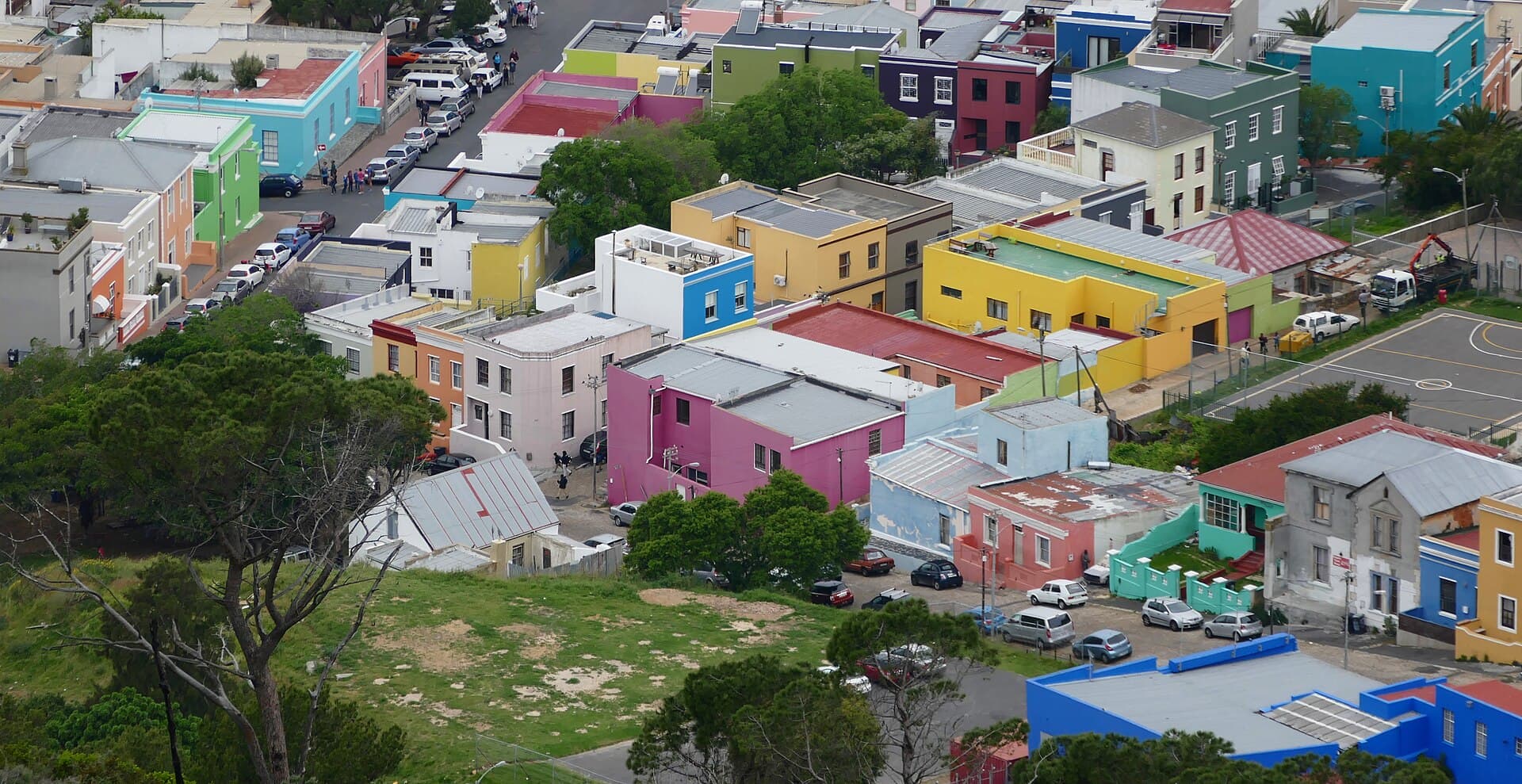
You see that history most vividly in Cape Town's Bo-Kaap, whose oldest rental houses date from the 1760s and which was declared a National Heritage Site on 30 April 2019. SAHRA records that it holds “the largest concentration of pre-1850 architecture in the country”, and that a Mosques of the Bo-Kaap Committee coordinates ten mosques within the neighbourhood.
Among them is the Auwal Masjid on Dorp Street — by its own account and that of South African History Online, the first and oldest mosque in South Africa, founded in 1794 (some sources give 1797–1798) on land made available by Saartjie van de Kaap, daughter of the freed slave Coridon van Ceylon. Its first imam was Tuan Guru, an exiled scholar imprisoned on Robben Island who wrote out the Qur'an from memory and established the country's first madrasah. It is still an active mosque today.
Halal food
Halal certification here is long-established and institutionally mature. The South African National Halaal Authority (SANHA), founded in 1996, publishes a searchable public directory of more than 2,500 certified establishments — over 1,000 of them retail outlets, alongside abattoirs, dairies, bakeries and a number of mainstream national restaurant chains.
For Gulf travellers one detail matters especially: SANHA has been accredited by the Emirates International Accreditation Centre (EIAC) since 2019 and the GCC Accreditation Centre (GAC) since 2017, and is recognised by JAKIM, MUIS, SASO and Qatar's Ministry of Public Health, among others. The Muslim Judicial Council Halaal Trust is the major Cape-based certifier, and the National Independent Halaal Trust, founded in 1992, certifies over 600 establishments nationwide. Cape Town Tourism maintains its own list of halal-certified and halal-friendly restaurants across the city, from fine dining to everyday takeaways.
Prayer facilities on arrival
You can pray before you have even left the airport.
- Cape Town International (CPT) has a Jamat Khana and a multi-faith prayer room at Parkade 2, Ground Floor, next to the SAPS station. Opened in 2010 and ACSA-owned, it is open 24 hours, accommodates men and women with ablution facilities for both, and holds Jumu'ah in congregation led by ACSA's imam, typically 12:45–13:45. During Ramadan, dates are provided so fasting travellers can break their fast.
- O. R. Tambo International (JNB) has a Muslim prayer facility open 24/7 with a Friday prayer service just after noon and separate male and female facilities, in the parkade nearest the Terminal A arrivals hall.
- King Shaka International (Durban) has one in the International Arrivals Hall, opposite the ATMs, and Chief Dawid Stuurman International (Gqeberha) has one on the first floor.
Note that Upington, Kimberley and Bram Fischer have no dedicated prayer facilities.
Mosques and Ramadan
Mosques are found across South Africa's major metros — a Gauteng City-Region Observatory survey documented 126 Muslim prayer facilities in the City of Johannesburg alone, the first established close to the city's founding in 1886. Durban's Juma Masjid, founded in 1881 by Memon traders, is the city's oldest; Durban Tourism and South African History Online both describe it as the largest mosque in the southern hemisphere, a title also frequently claimed for the Nizamiye Mosque in Midrand, which opened in 2012, seats 6,000 and is modelled on the Selimiye in Edirne. The claim is contested, so we attribute it rather than settle it.
Ramadan is publicly observed and practically accommodated. Cape Town keeps a formalised moon-sighting tradition: the maankykers, organised since 1952 as the Crescent Observer's Society, watch for the new crescent from two points chosen centuries ago — Signal Hill and Three Anchor Bay — and the new month is announced on local radio.